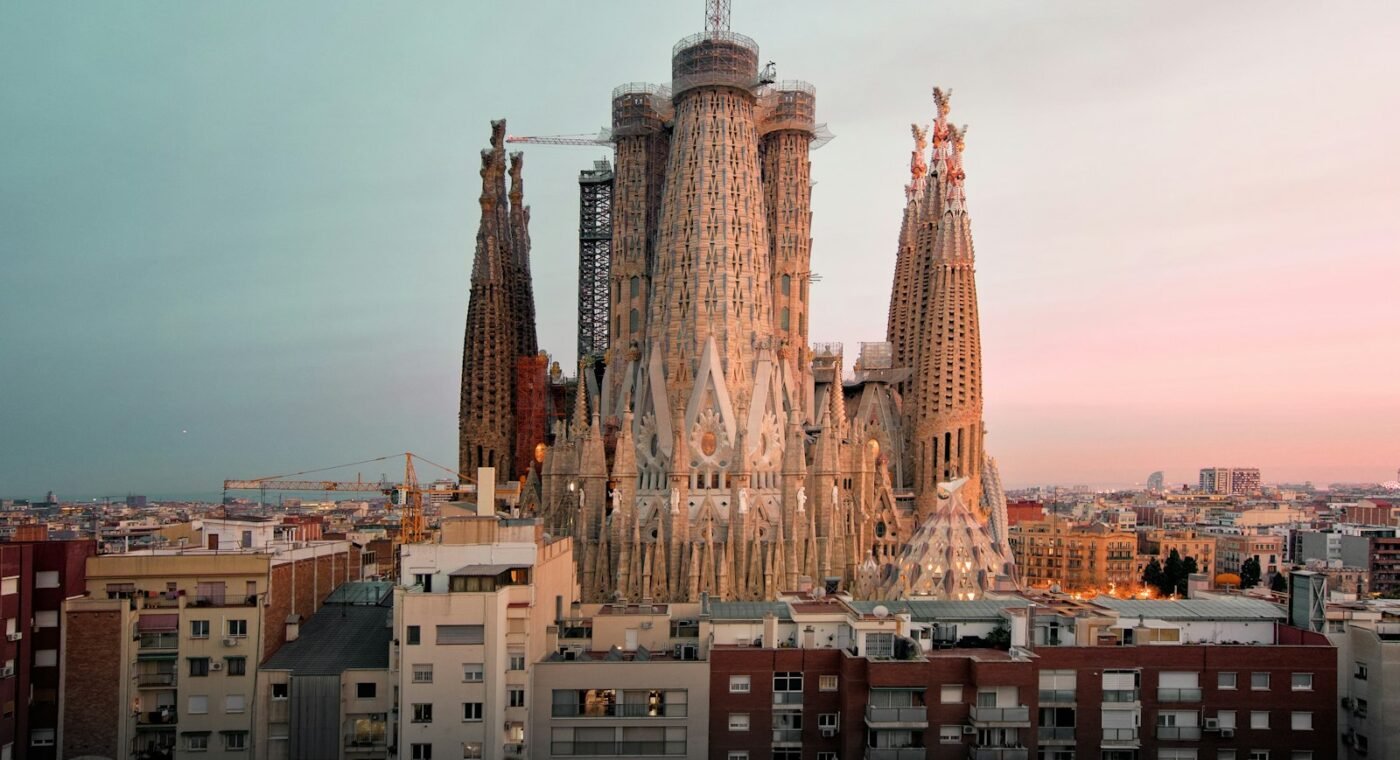
Construction of the Sagrada Família in Barcelona has been going on for more than 140 years, but the basilica conceived by Antoni Gaudí is now ready to emerge from its scaffolding. The milestone coincides with the centenary of the architect’s death and the completion of the Tower of Jesus Christ, which raises the temple to 172.5 metres and puts it above Ulm Minster in Germany as the tallest church in the world.
The biggest structural challenge was the six central towers, hyperbolic structures designed to withstand wind, earthquakes and heavy loads. The towers were divided into 826 modular panels containing more than 2,100 pieces of stone, pre-assembled at the quarry and bonded with a two-component epoxy adhesive developed by Germany’s Henkel after a decade of research and produced in Montornès del Vallès.
Each panel takes about 30 kilograms of resin and cures for 24 hours at a controlled temperature before being transported, lifted and assembled level by level. According to project manager Begoña Cantera, the method is up to ten times faster than conventional construction: work completed in about eight years would have taken between 50 and 60. In total, 24 tonnes of adhesive were used.
The solution had to cope with salty Mediterranean air 2.5 kilometres away, relative humidity of between 65% and 75%, and vibrations from two metro lines running beneath the basilica. The Tower of Jesus Christ, crowned by a 17-metre cross, is expected to open to the public from 2027 as a viewing platform.