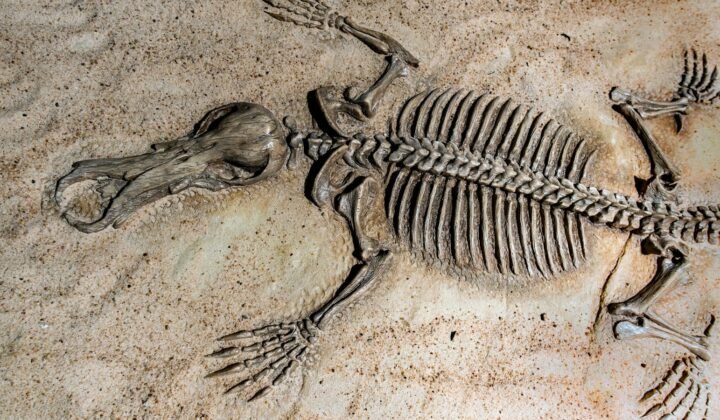
Researchers from the CNRS and the Muséum national d’Histoire naturelle in Paris have described a new species of mosasaur, named Garamaudo bauciensis, discovered near Aix-en-Provence, in south-eastern France. The animal lived around 85 million years ago, in the Late Cretaceous, in a lake environment.
The discovery is surprising because mosasaurs were thought to be exclusively marine reptiles. Freshwater fossils, including molluscs, were found at the same site, reinforcing the idea that this specimen lived in a lake.
Around 2.5 metres long, the animal had legs instead of the flippers typical of open-sea mosasaurs, combining terrestrial and aquatic features. Its unusually dense bones would have helped it stay submerged in shallow waters.
The study, published in PCI Paleontology, was led by Nathalie Bardet and Alexandra Houssaye, with the collaboration of the Muséum départemental du Var, the Muséum d’Histoire naturelle d’Aix-en-Provence and the Réserve naturelle nationale Sainte-Victoire.