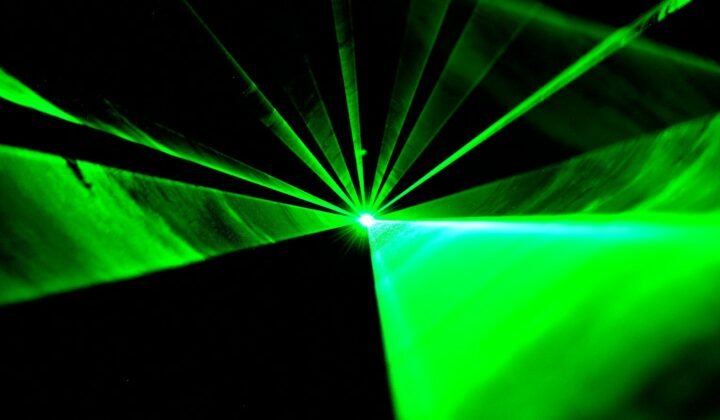
Researchers at North Carolina State University in the United States have demonstrated a new type of radio antenna that, instead of a metal structure, uses a laser to create a thin filament of plasma in the air. The result, which resembles a lightsaber, was published in the IEEE Journal of Microwaves.
The laser ionises a narrow strip of air and turns it into plasma, which conducts electricity. To feed it a signal without physical contact, the team used a metal ring that acts as a capacitor: the laser passes through the centre and the ring’s electromagnetic field makes the filament emit radio waves. Transmission was demonstrated at 30 megahertz.
Because the filament’s length and direction depend on the laser settings, the antenna could in future adapt to different frequencies and point wherever needed without moving parts, which is of particular interest for satellites, radar and space exploration.
The authors stress that this is only a first step: receiving signals and operating across a wide range of frequencies still need to be tested. Even so, it is the first time an antenna of this kind has been shown to work.